Batch 06: PUNK-ish IPA
- Style
- IPA
- Status
- Complete
- Brewed
Photograph
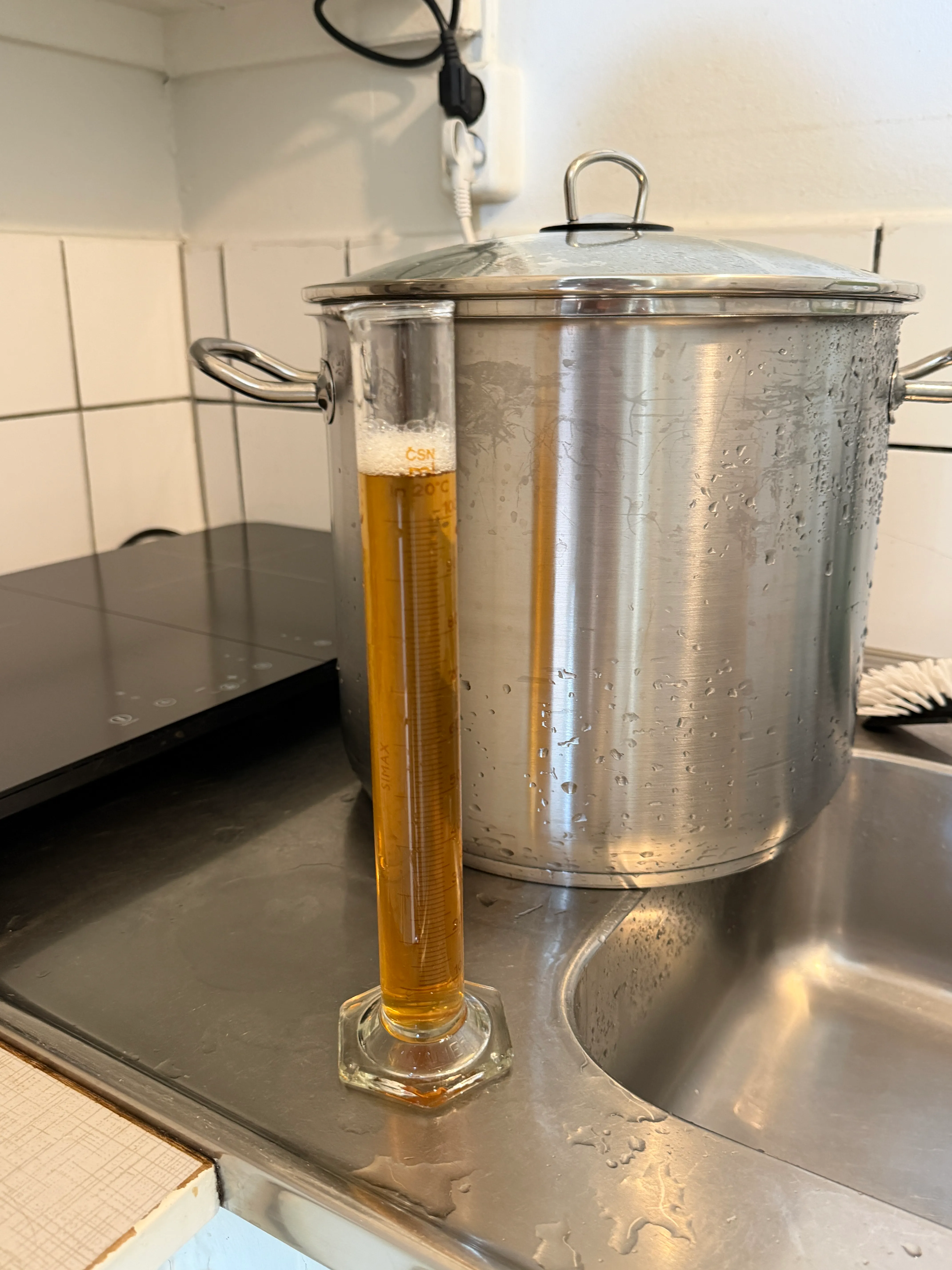
Look for
A pronounced hop aroma, citrus and tropical fruit alongside some pine and resin, and enough bitterness to balance the malt. See how the cooler-than-planned hop stand and heavy dry hopping affect the finished beer.
About this batch
A hop-heavy take on the classic Punk IPA, with generous late hopping and a substantial dry hop.
Inspired by BrewDog's Punk IPA and its published homebrewing recipe, this is an attempt to make a similarly expressive, hop-forward beer on my small all-grain setup. Chinook and Ahtanum provide much of the hot-side hopping, with Simcoe, Nelson Sauvin, and Cascade contributing to the later additions.
The brew did not go entirely to plan. The hop stand cooled below its intended temperature, and recovering more wort from the kettle brought an unusually large amount of hop sediment into the fermenter. The dry-hop plan was consequently reduced from 95 g to 75 g to limit further losses. Added 75.8 g on 3 November, then cold crashed before bottling on 11 November. The bottles are now conditioning; finished-beer tasting is still pending.
Recipe
Reference recipe: BrewDog's Punk IPA 2010 – Current
- Volume
- 10 L
- OG (original gravity)
- 1.052
- FG (final gravity)
- 1.010
- ABV (alcohol by volume)
- 5.7%
- Yeast
- US-05
- Yeast amount
- 8.5 g
- Fermentation
- 24 days · 18–20°C
- Packaging
- Bottles
- Malt
- 2.2 kg Pale Ale malt
- 130 g Carahell
- Hops
- Chinook · 46.5 g
- Ahtanum · 33.7 g
- Simcoe · 21.4 g
- Nelson Sauvin · 14.3 g
- Cascade · 24 g
- Ingredients
- Protafloc · 0.3 g
- Clarity Ferm
Hop schedule
- Chinook · 10 g and Ahtanum · 6.2 g at 60 minutes remaining
- Chinook · 10 g and Ahtanum · 6.2 g at 15 minutes remaining
- Chinook · 13.5 g at the start of a 30-minute hop stand
- Ahtanum · 6.3 g, Simcoe · 6.4 g, and Nelson Sauvin · 6.3 g after 10 minutes of the hop stand
- Dry hop planned: Chinook · 13 g, Ahtanum · 15 g, Simcoe · 15 g, Nelson Sauvin · 8 g, and Cascade · 24 g
Brew log
| Stage | Record |
|---|---|
| Mash · 18 October 2026 | Mashed 2.2 kg Pale Ale malt and 130 g Carahell using brew in a bag (BIAB), with 10 L of water at a target of 66°C for 75 minutes. |
| Rinse | Rinsed the grain bag with 4 L of water at approximately 75°C, collecting roughly 12 L of wort for the boil. |
| Boil | Boiled for 60 minutes, following the planned early and mid-boil hop additions.
|
| Hop stand | Planned a 30-minute hop stand at 80°C. Actual temperature was approximately 72°C at the beginning and fell to 65°C by the end. Kept the original 30-minute duration rather than reheating or extending it.
|
| Cooling | Continued cooling after the hop stand, reaching approximately 22°C by 14:55.
|
| Transfer and hop sediment | An unusually large amount of hop material remained in the kettle. Initially transferred approximately 6.4–6.5 L of clearer wort, then recovered additional wort along with substantial sediment, reaching about 8.4 L in the fermenter.
|
| Gravity and dilution | Initial measured gravity was 1.058. Diluted the recovered wort in stages, then added a final 800 mL of water to reach 10 L in the fermenter.
|
| Yeast and fermentation | Pitched 8.5 g US-05 and fermented at 18–20°C.
|
| Revised dry-hop plan | Reduced the intended dry hop from 95 g to 75 g because the fermenter already contained so much hop sediment.
|
| Dry hop · 3 November | Added 75.8 g of loose hops directly to the fermenter. Gravity before dry hopping was 1.010, used as the recorded FG.
|
| Cold crash · 9 November | Moved the fermenter outdoors ahead of bottling, with temperatures around 1–5°C, to help settle yeast and hop particles.
|
| Bottle · 11 November | Bottled after 24 days in the fermenter, using the same priming approach as the cider and Batches 04 and 05. Dissolved sugar in water and dosed the solution individually into each bottle using a pipette.
|
| Reflections | The recipe was broadly followed, but the cooler hop stand and heavy trub transfer were the two major deviations. The beer reached the intended 10 L fermenter volume through dilution, with an estimated OG of 1.052.
|
Notes
- Final fermenter volume was 10 L, including a substantial amount of hop sediment. This does not represent the volume expected to reach bottles.
- Final OG of 1.052 is estimated from the last dilution. Gravity was not remeasured after the final 800 mL of water was added.
- The recipe retains the original hop quantities and planned dry-hop schedule. The actual 75.8 g addition is recorded below; the 3 November notes name Centennial where the recipe specifies Ahtanum. This discrepancy remains unresolved.
- Clarity Ferm was added around pitching, but the dose is not confirmed. The earlier discussion mentioned 4 mL. Gelatin was considered but ultimately skipped.
- Recorded FG is 1.010, based on the measurement before dry hopping on 3 November. No gravity measurement was taken on bottling day.
- OG 1.052 and FG 1.010 give approximately 5.5% ABV before priming. The recorded 5.7% includes the standard assumed contribution of 0.2 percentage points from bottle priming.
- Confirm the actual yeast pitch date and temperature. Record whether the thermometer used for this batch was checked or replaced after the malfunction during Batch 04.
- Hop alpha-acid percentages would make the recipe easier to reproduce.
- Exact bottled yield and priming quantities are not recorded. Carbonation and finished-beer tasting remain to be evaluated after conditioning.