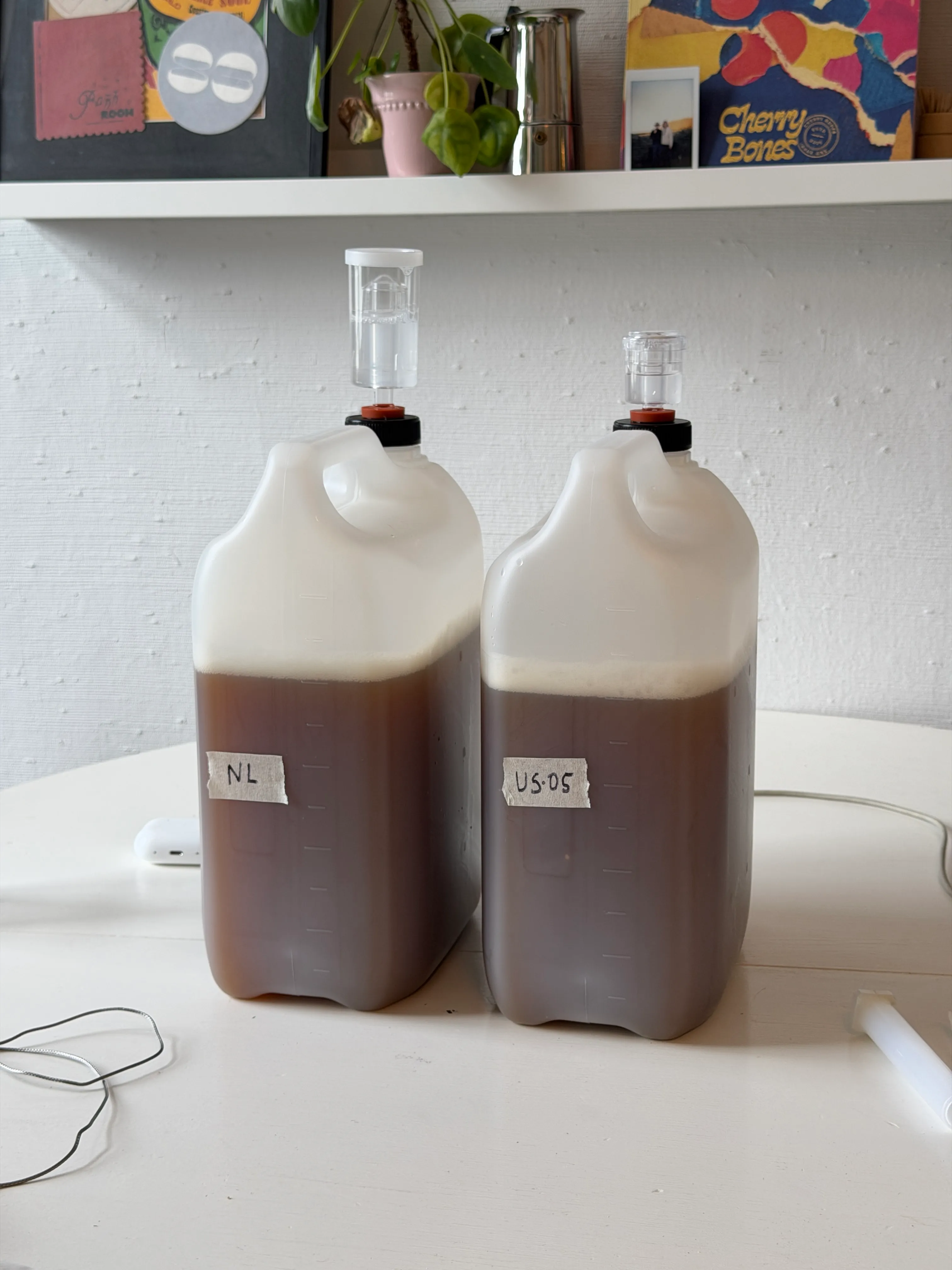
| Shared brew day · 16 October 2026 | This record covers the wort preparation for both Batch 04 and Batch 05. Recipe ingredient quantities above are per fermenter; the hop schedule and brew-day quantities below cover the entire shared wort. |
|---|
| LME preparation | Started with slightly over 6 L of water in the main pot. With the heat off, added the full 1.2 kg of Coobra Light LME. - The bag was cut open across its full width. It was easy to rinse, but the extract poured out almost all at once; a slower, more controlled pour would be preferable.
- Rinsed the bag twice to recover nearly all the extract. After the first rinse the kettle was approaching 8 L; a second, smaller rinse brought it to approximately 8 L before boiling.
- Surprisingly pleasant malt aroma, but considerably darker wort than expected. Glad to have chosen light rather than medium extract.
- No obvious significant scorching or sticking. Dissolving the extract caused no obvious serious problems.
- Account for the volume of the extract and bag-rinsing water when choosing the initial water volume. Underestimating the extract's own volume was the main oversight.
|
|---|
| Boil | Actual total boil was 45 minutes. The first 15 minutes had no hops, followed by the scheduled 30-minute hop boil. - Elapsed 0 minutes: boil started.
- Elapsed 15 minutes: added 6.1 g Simcoe, giving 30 minutes in the boil.
- Elapsed 35 minutes: added 6.3 g Ahtanum, giving 10 minutes in the boil.
- Elapsed 45 minutes: flameout.
- Protafloc was omitted, saving the remaining supply for PUNK-ish IPA.
|
|---|
| Hop stand | Planned 15 minutes at 80°C, but the wort cooled faster than expected before the hops were added. Actual stand was 20 minutes starting at approximately 70°C, with no additional heat. - Added 13.2 g Nelson Sauvin and 5.1 g Cascade. Cascade was deliberately reduced from the original 10 g plan to approximately 5 g, saving some for the future Brut IPL.
- Elapsed 0 minutes: 70°C, hop stand started.
- Elapsed 10 minutes: 67°C, stirred the wort.
- Elapsed 20 minutes: 65°C, hop stand finished.
- Temperature declined gradually. Stirring resuspended considerable hop material; the wort was then left undisturbed to encourage settling.
- For PUNK-ish IPA, start closer to 80°C to allow more temperature margin. The higher temperature may also change extraction and bitterness.
|
|---|
| Initial dilution | Post-boil wort volume was estimated at approximately 6.0–6.1 L. Added approximately 2 L water directly to the kettle to reach approximately 8 L. - Mixed the shared wort before splitting to make the concentration uniform. Diluting in the kettle simplified the split and reduced starting-gravity differences.
|
|---|
| Cooling setup | Cooled the pot in a kitchen sink cold-water bath with a continuous flow of fresh cold tap water and two frozen ice packs in the surrounding water. - Stirred the external cooling water approximately every 2–5 minutes and stirred the wort periodically to improve circulation.
- The lower kettle fill allowed sink water above the wort level, improving contact with the sides of the pot compared with earlier sessions.
- Wort stirring appeared useful, although it resuspended hops.
|
|---|
| Thermometer malfunction | The digital thermometer gave inconsistent readings. Actual cooling temperatures and pitching temperature cannot be reliably reconstructed; the apparent slow cooling was misleading. - Unreliable displayed readings only, not confirmed wort temperatures: approximately 15 minutes, 50°C; 20 minutes, 47°C; shortly afterward, 44°C.
- Further checks displayed approximately 42°C in cooling water believed to be near 10°C, and approximately 45°C in room air around 20–22°C.
- Stainless steel probe with a braided metal cable and 2.5 mm jack. Moisture entering the probe or cable junction is a possible cause, not a confirmed diagnosis.
- Near-room temperature in approximately 30 minutes is plausible but unconfirmed. Do not use these displayed readings for cooling-performance comparisons.
- Test the thermometer in an ice-water bath. Allow the probe to dry or replace it if necessary; reliable temperature measurement is a priority for future brews.
|
|---|
| Transfer and final dilution | After cooling, divided the wort between two fermenters, initially approximately 3.3–3.4 L each at measured gravity 1.050. - Added 500 mL water to each fermenter to increase yield and reduce expected alcohol content.
- Final recorded volume was 3.9 L per fermenter; final measured OG was 1.045 in both.
- Some hop sediment transferred. This was accepted because most should settle during fermentation and can be avoided when siphoning at bottling.
|
|---|
| Clarity Ferm and pitching | Added 2 mL Clarity Ferm to each fermenter using a pipette. Both yeasts were pitched on 16 October 2026; actual pitching temperature was not reliably measured. - Batch 04: 3.0 g SafAle US-05 in 3.9 L, measured OG 1.045.
- Batch 05: 3.0 g LalBrew NovaLager in 3.9 L, measured OG 1.045.
- The recently purchased pipette made small liquid additions easier and more accurate, a noticeable improvement in brewing ergonomics.
|
|---|
| Reflections | LME made wort preparation considerably simpler, with no mash or sparge. The process appears practical for small experimental batches, but finished flavour quality remains untested. - Pleasant aroma, straightforward dissolving, and thorough bag rinsing were positives. Improve pour control and initial volume planning; the darker appearance was unexpected.
- The lower kettle fill improved sink immersion, and circulation appeared better. Cooling may have been more efficient than initially believed, but the faulty thermometer prevents a reliable comparison.
- Preparing, diluting, and mixing one shared wort was straightforward. Both fermenters reached the same measured OG and received equal yeast quantities and Clarity Ferm doses.
- Evaluate practical time and equipment needs alongside fermentation and eventual tasting. It is too early to judge LME flavour quality against all-grain brewing.
|
|---|